Lesson planning for teachers whose brains don’t do binders
Hi, I’m Courtnay, co-founder of CARL. I have ADHD, and, plot twist, I LOVE a good workflow. Not because organization comes naturally to me. Because it doesn’t. If I can’t see something, it stops existing (object permanence is a struggle), so I build systems that put the whole picture where I can see it. CARL and Compass are that kind of system, built for teachers.

A note from someone who gets the brain, and respects the job.
I’m not a teacher. I won’t pretend to know what it’s like to manage thirty kids while remembering which outcome Tuesday’s lesson was serving (I have two, and that’s plenty for me). But education matters enormously to me, and I know, from the inside, what it costs to run a demanding job on a brain that charges a premium for every act of executive function.
Workflows are puzzles I do for fun, but willpower and working memory have never been enough to carry me. The system has to hold the whole picture, because my head won’t hold it for me. So I build the structure while I’m hyperfocused, and trust it to carry me the rest of the way.
That’s the principle CARL and Compass are built on: keep the whole plan visible, make the next step obvious, and never start from a blank page. And if your brain is the tidy kind that doesn’t need any of this? Good systems are just good systems, and you’re welcome too.
Object permanence for your curriculum.
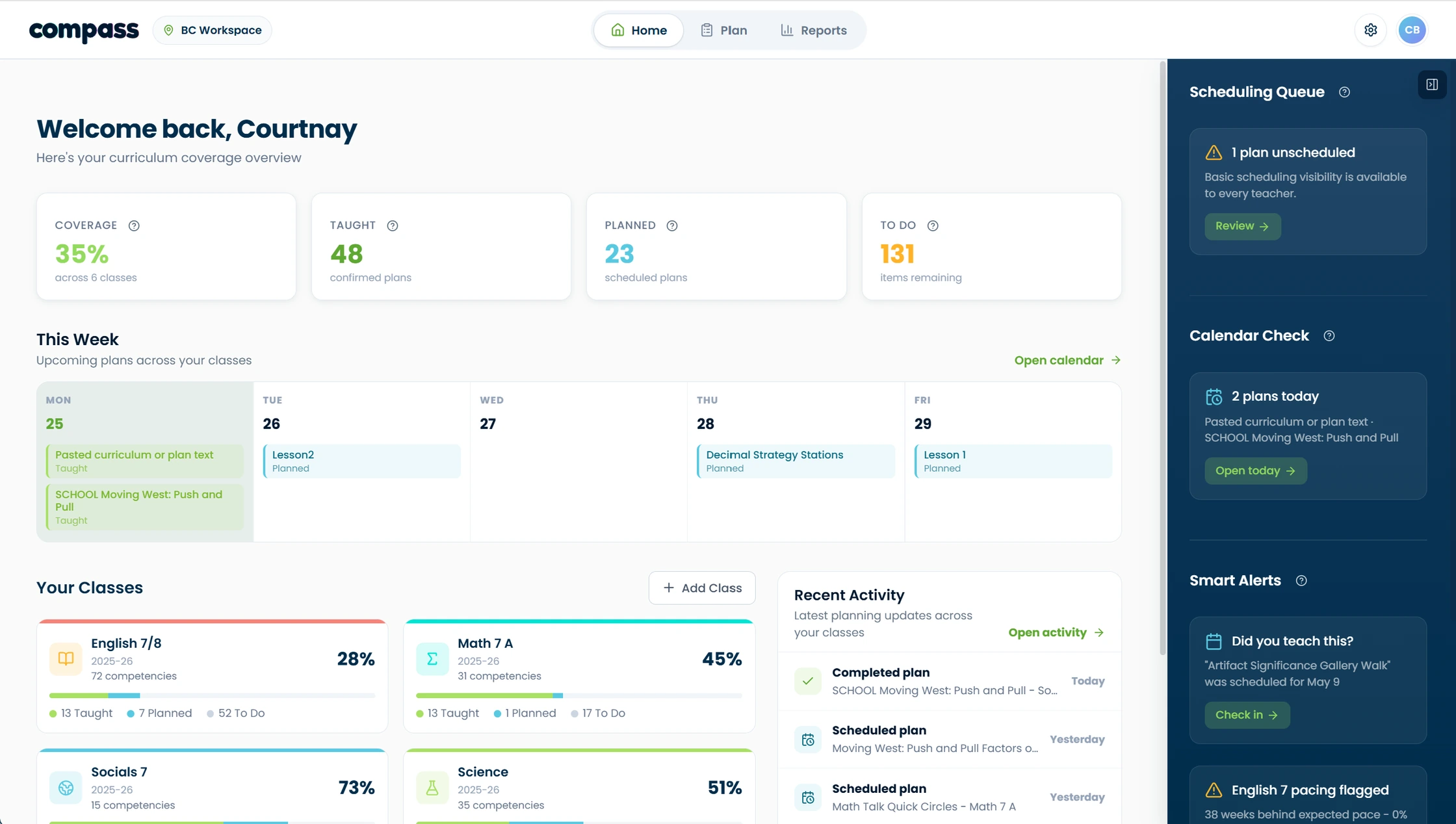
You know the rule: out of sight, out of mind. If the coverage tracker lives in a drawer, a spreadsheet, or your own head, it essentially doesn’t exist, and neither do the outcomes hiding in it. Compass’s whole job is to keep your curriculum where your brain can’t lose it: taught, planned, and still-to-come, across every class, in one visual map.
No spreadsheet to maintain. No highlighter system to abandon in November. The tracking updates as a byproduct of planning, so “am I forgetting something?” gets a one-glance answer instead of a 2 a.m. spiral.
You can’t just make the plan. First you have to plan to make the plan.
Planning with ADHD is forty open tabs and no bookmark bar. The lesson idea is in there somewhere, along with the curriculum doc, the half-finished worksheet, and the thing you were definitely going to remember. Lesson planning demands exactly what ADHD taxes hardest: starting from nothing, holding details in working memory, sequencing weeks ahead, and switching between tools without dropping the thread. Most advice is “be more organized,” which is like curing nearsightedness with “squint harder.”
Free to start. No personal student data.
Where the planning energy actually goes (and what the system picks up)
“I can’t start.”
Task initiation is the hardest part. Four low-activation entry points: type a topic, talk it out, upload whatever half-thing exists, or remix someone else’s lesson.
“I lost the plan I made.”
Everything lives in one place, attached to the class it belongs to. No archaeology through downloads folders.
“I made the lesson but not the worksheet.”
Materials generate from the same lesson context, so finishing doesn’t require restarting.
“I have no idea what I’ve actually covered.”
That’s Compass. It shows coverage in one view, because “I think we did that?” is not a reliable tracking system.

The same design thinking can support your students too.
The same thinking helps you plan for the ADHD, autistic, and otherwise neurodivergent kids in your room: UDL options, chunked instructions, visual supports, and differentiated versions are one request away, attached to the lesson instead of bolted on at midnight.
Questions teachers ask first.
Plan the lesson while you still feel like planning it.
Open CARL, type the topic that’s in your head right now, and let momentum do the rest.