Lesson Builder & Remixing

A full draft in minutes. Yours to shape.

However you start, CARL builds a structured, curriculum-aligned draft you can edit block by block. You decide what stays.
Curriculum-aligned Planning preferences Teacher-controlled outputs No student data needed
Connected Workflow

From planning preferences to classroom-ready materials

CARL turns teacher-set planning choices into a connected workflow: the lesson, student materials, teaching supports, and coverage tools can all build from the same setup.
1 Choose your setup Curriculum mode, language options, grade, subject, timing, and planning preferences.
2 Build the lesson Give CARL an idea, a file, or a library lesson and get a structured draft back.
3 Add what goes with it Generate materials and supports that match the lesson you just built. Worksheets & Activities →
Lesson Builder

Start where you are

Use the path that matches your planning moment: a blank idea, an existing document, a library lesson, or a conversation.
Start from Scratch
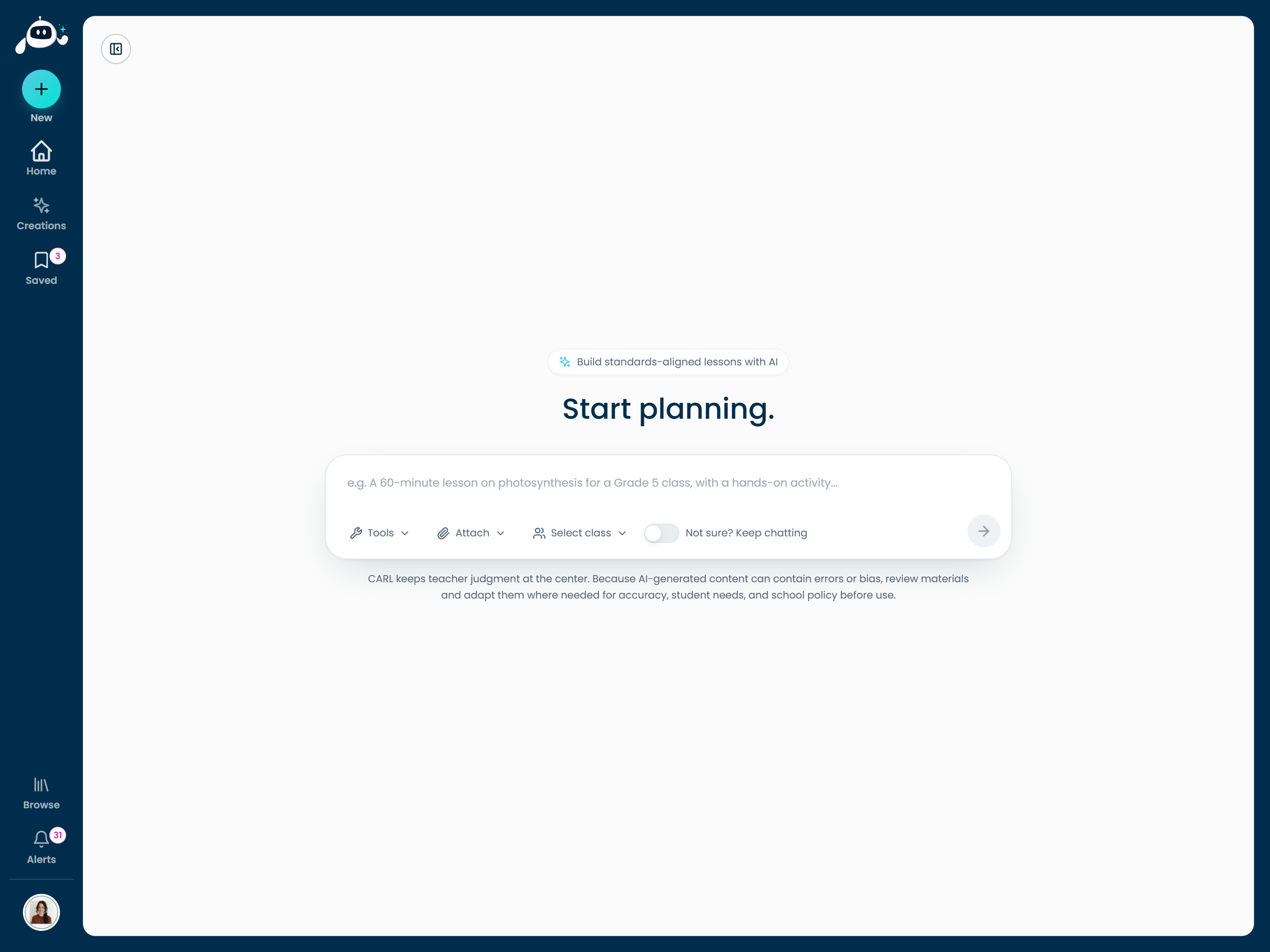
Tell CARL what you are teaching and choose your setup. CARL builds a structured, curriculum-aligned draft you can review and revise.
1Enter topic, grade, and planning preferences
2Generate an editable lesson draft
3Add components, supports, and resources
Learn the planning workflow
CARL also supports
Upload & EnhanceStart from a PDF, Word doc, notes, or an existing lesson.
Remix a LessonMake a shared library lesson your own, without changing the original.
Chat with CARLPlan through a conversation, then move it into the builder.
hicarl.ai
Starting a new lesson in CARL, the Start planning screen
Check Your Curriculum

Not sure if your curriculum is covered?

Search your province, state, or framework. If it’s not built in, upload your own.
Browse what CARL supports
Don’t see yours?Upload your district, school, or teacher-created curriculum and CARL aligns to it instead.
The Editor

Every lesson is yours to edit

CARL drafts a starting point. You shape it: rearrange, rewrite, add, or remove any part in a clean editor built for teachers, not a locked template.
A lesson open in the CARL editor, ready to edit
Edit any block

Rewrite, expand, or trim any part of the plan. Nothing is locked; it is your lesson.

Rearrange in seconds

Move sections into the order that matches how you actually teach the lesson.

Ask CARL

Get suggestions for changes or improvements right in the editor with the Ask CARL feature.

See what CARL builds

A real lesson, ready to teach

Every plan comes out structured, curriculum-aligned, and yours to edit. Here are a few examples across subjects.
1Learning standards 2Assessment & proficiency scale 3Learning experiences 4Reflect & revise
Sample lesson planStructured, curriculum-aligned, and yours to edit

Preview coming soon

A real CARL document will render here, scrollable and ready to print.

Five subjects, one workflow: from a Grade 1 read-aloud to a two-day Grade 10 unit. Scroll a plan, or open it full size to read it. Learn more about worksheets →

Engagement hooks

Openers that make students want the answer

Give CARL a topic and every lesson opens with two short, everyday scenarios that tie it to something students already know and care about. The two hooks take different angles on the same idea, so more of your class finds a way in.
Your topic
Pythagorean theorem

That’s all CARL needs. Both hooks are written for your grade, from your lesson.

Pythagorean TheoremWritten by CARL · two ways in
Programming a Robot Path
A robotic vacuum needs to travel from one corner of a room to the opposite corner. The programmer knows the exact length and width of the room but needs to code the diagonal path.
How can a computer calculate a diagonal path without measuring it?
Building a Skate Ramp
Skateboarders want to build a wooden ramp with a specific height and a flat base length. They need to buy a single piece of plywood for the slanted surface.
How can we determine the ramp length before buying the wood?
Your topic
Consent and boundaries

Different subject, same saved class profile.

Consent & BoundariesWritten by CARL · two ways in
Passing the Ball
A teammate keeps taking the ball from you during practice without calling for it, even though you had a clear shot. Later, another teammate waits for your nod before running a play together.
Why does the second play feel more like a team effort?
Joining the Co-op Lobby
Your friend joins your online game lobby and immediately changes your character’s gear and settings without asking. In a different game, a teammate sends a chat request before customizing any shared team resources.
What makes the second teammate’s approach feel more respectful?
Your topic
Picture clues

That’s all CARL needs. Both hooks are written for your grade, from your lesson.

Picture CluesWritten by CARL · two ways in
The Grey Paint Brush
A painter is working on a bright sunny park scene, but then they mix a giant blob of dark grey paint. They hold their wet brush directly over the bright blue sky.
What is about to change on the painter’s paper?
The Slippery Banana Peel
In a cartoon, a character drops a slippery banana peel on the sidewalk. Another character walks toward it while looking up at a flying bird.
What is going to happen when their foot reaches the peel?
Your topic
Forces in motion

That’s all CARL needs. Both hooks are written for your grade, from your lesson.

Forces in MotionWritten by CARL · two ways in
The Delicate Robotic Grip
Modern robotic arms in factories use special sensors to hold fragile items like eggs or glass bottles. If the robot squeezes too hard the item breaks, but if it grips too loosely the item slips and falls.
How does the machine keep the object perfectly still?
The Ultimate Block Tower
During a game of stacking wooden blocks, the tower stands perfectly still for several minutes as players carefully add to the top. Suddenly, one tiny touch makes the entire structure wobble and crash to the table.
What changed to make the still blocks suddenly move?
Your topic
The human impact of war

A two-day opener: CARL writes a fresh pair of hooks for each day.

Day 1 · Investigating civilian experiences
The Human Impact of WarWritten by CARL · two ways in
When the Network Goes Down
A sudden storm knocks out the local cell towers and power grid for three days, leaving everyone without internet, navigation, or digital payment systems. Neighbors who never talk to each other suddenly have to share physical tools, water, and paper maps to get through the week.
How do people adapt when their everyday tools suddenly stop working?
Packing Only the Essentials
A sudden emergency requires leaving the house immediately with only one small backpack of belongings. Most people instinctively grab items that hold deep personal memories rather than practical tools for survival.
Why do we value sentimental items when our physical safety is threatened?
Day 2 · Causes and consequences of displacement
The Human Impact of WarWritten by CARL · two ways in
Navigating Without a Map
GPS systems occasionally fail in unfamiliar territory, forcing drivers to rely on physical landmarks, hand-drawn sketches, or advice from strangers to find their way. This journey becomes much more stressful when the destination itself is completely unknown.
What helps a person find direction when all familiar paths disappear?
Joining an Unfamiliar Group
Entering a new school or joining an established club mid-year means navigating unspoken rules, unfamiliar slang, and different social expectations. It takes time to feel secure when trying to fit into a community that already has its own history.
How do people rebuild their sense of belonging in a new space?
Your topic
SOAPSTone analysis

That’s all CARL needs. Both hooks are written for your grade, from your lesson.

SOAPSTone AnalysisWritten by CARL · two ways in
The Gallery and the Wall
A local artist paints a massive, bright mural on a crumbling brick wall in a quiet neighborhood, then paints the exact same design on a canvas for a high-end gallery downtown. The mural sparks a community block party, while the canvas sells for thousands to a private collector.
Why does the same artwork feel completely different in these two spaces?
The Trailer Remix
A director releases a dramatic movie trailer with slow, tense music for a film festival crowd, then edits the same footage with fast, upbeat music for a social media ad. Festival viewers expect a deep character study; the online audience expects a high-energy thriller.
How does changing the music change who wants to watch the movie?
Even the hard topics get an approachable way in. Notice how the Consent and War openers stay in safe, everyday territory: a practice, a game lobby, a storm, a new school. Students are never asked to relive a boundary crossing or a displacement. That restraint is deliberate, and it pairs with the trauma-informed supports built into every lesson.
Built together

Good lessons don’t have to start from nothing

Every lesson a teacher shares becomes a starting point for someone else. Find one close to what you need, make it yours, and republish. A remix tree always shows who built what.
Remix tree
  • Original The Water Cycle Grade 4 · by Ms. Alvarez
    • Remix The Water Cycle: French Immersion by M. Tremblay + French student materials
    • Remix Water Cycle + Hands-on Lab by Mr. Chen + lab activity & worksheet
      • Remix of a remix Water Cycle + Lab (ELL) by Ms. Okafor + ELL scaffolds & glossary

Every version keeps its history. Authorship stays visible at every step.

Remix instead of rebuild

Found a lesson that’s almost right? Open it, change what your class needs, and republish. It’s an independent copy, so your changes and theirs never affect each other.

Add your own components

Swap in a different worksheet, activity, or assessment. Your additions travel with your version, and the lineage credits what you added.

A remix tree that shows the whole lineage

See who created a lesson, who remixed it, and how it changed, traced all the way back to the original.

The more teachers share, the less anyone starts from a blank page. That’s the idea: a library that grows more useful the more it’s used.

Flexible Planning

Plan on your terms

CARL adapts to how you actually plan: whichever curriculum you follow, whichever language you teach in, and it connects to Compass when you want to track what you’ve covered.
Curriculum modes

A built-in mode or your own documents; CARL aligns the lesson and lists the outcomes it covers.

Canadian provinces UK Common Core Universal Custom docs
Language options

Generate lessons in English, French, French Immersion, or Spanish. More language supports live in Built-in Supports.

English French French Immersion Spanish Partial integration
Compass coverage

Plan in CARL, then book it into Compass so it lands on your schedule and shows as planned.

Planned Taught To Do Plan Ideas Reports
Explore Compass

Frequently Asked Questions

Common questions from educators about using CARL
CARL mascot with a question mark
Yes. Upload a PDF, Word doc, or your own notes and CARL structures and aligns them, and you can bring in your own curriculum documents as a custom mode.
Yes. Lessons can be generated in English, French, French Immersion, or Spanish, and language options are part of the planning setup.
No. CARL plans from teacher-set preferences: curriculum mode, grade, subject, language options, timing, and class-level needs. No student names or personal student data required.

Ready to build your next lesson?

Start from scratch, an upload, a remix, or the shared library, then shape every part.

CARL beside a bookshelf of lessons and plants